

 |
Legal instruments on: Passage |
Page 1: from paragraph 1 to 10 out of 49
Continent: International
Country: All Countries 🌍1. United Nations Convention on the Law of the Sea, Article 124, Paragraph 1: 🌍
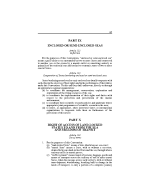
For the purposes of this Convention: (a) "land-locked State" means a State which has no sea-coast; (b) "transit State" means a State, with or without a sea-coast, situated between a land-locked State and the sea, through whose territory traffic in transit passes; (c) "traffic in transit" means transit of persons, baggage, goods and means of transport across the territory of one or more transit States, when the passage across such territory, with or without trans- ... 📑Read more
2. United Nations Convention on the Law of the Sea, Part 2, Section 2, Article 8, Paragraph 2: 🌍

2. Where the establishment of a straight baseline in accordance with the method set forth in article 7 has the effect of enclosing as internal waters areas which had not previously been considered as such, a right of innocent passage as provided in this Convention shall exist in those waters. 📑Read more
3. United Nations Convention on the Law of the Sea, Part 2, Section 3, Article 17, Paragraph 1: 🌍

Subject to this Convention, ships of all States, whether coastal or land-locked, enjoy the right of innocent passage through the territorial sea. 📑Read more
4. United Nations Convention on the Law of the Sea, Part 2, Section 3, Article 18, Paragraph 1: 🌍
Passage means navigation through the territorial sea for the purpose of: (a) traversing that sea without entering internal waters or calling at a roadstead or port facility outside internal waters; or (b) proceeding to or from internal waters or a call at such roadstead or port facility. 📑Read more
5. United Nations Convention on the Law of the Sea, Part 2, Section 3, Article 18, Paragraph 2: 🌍
Passage shall be continuous and expeditious. However, passage includes stopping and anchoring, but only in so far as the same are incidental to ordinary navigation or are rendered necessary by force majeure or distress or for the purpose of rendering assistance to persons, ships or aircraft in danger or distress. 📑Read more
6. United Nations Convention on the Law of the Sea, Part 2, Section 3, Article 19, Paragraph 1: 🌍

Passage is innocent so long as it is not prejudicial to the peace, good order or security of the coastal State. Such passage shall take place in conformity with this Convention and with other rules of international law. 📑Read more
7. United Nations Convention on the Law of the Sea, Part 2, Section 3, Article 19, Paragraph 2: 🌍
Passage of a foreign ship shall be considered to be prejudicial to the peace, good order or security of the coastal State if in the territorial sea it engages in any of the following activities: (a) any threat or use of force against the sovereignty, territorial integrity or political independence of the coastal State, or in any other manner in violation of the principles of international law embodied in the Charter of the United Nations; (b) any exercise or ... 📑Read more
8. United Nations Convention on the Law of the Sea, Part 2, Section 3, Article 21, Paragraph 1: 🌍
The coastal State may adopt laws and regulations, in conformity with the provisions of this Convention and other rules of international law, relating to innocent passage through the territorial sea, in respect of all or any of the following: (a) the safety of navigation and the regulation of maritime traffic; (b) the protection of navigational aids and facilities and other facilities or installations; (c) the protection of cables and pipelines; (d) the cons ... 📑Read more
9. United Nations Convention on the Law of the Sea, Part 2, Section 3, Article 21, Paragraph 4: 🌍

Foreign ships exercising the right of innocent passage through the territorial sea shall comply with all such laws and regulations and all generally accepted international regulations relating to the prevention of collisions at sea. 📑Read more
10. United Nations Convention on the Law of the Sea, Part 2, Section 3, Article 22, Paragraph 1: 🌍
The coastal State may, where necessary having regard to the safety of navigation, require foreign ships exercising the right of innocent passage through its territorial sea to use such sea lanes and traffic separation schemes as it may designate or prescribe for the regulation of the passage of ships. 📑Read more




Please log in or register to access this content. Logging in will grant you acess to subscriber contents like unlimited access to our articles, glossaries, lexicons, quizzes, downloads, forum participation, etc.