Read entire PDF
Opens in new tab ↗️


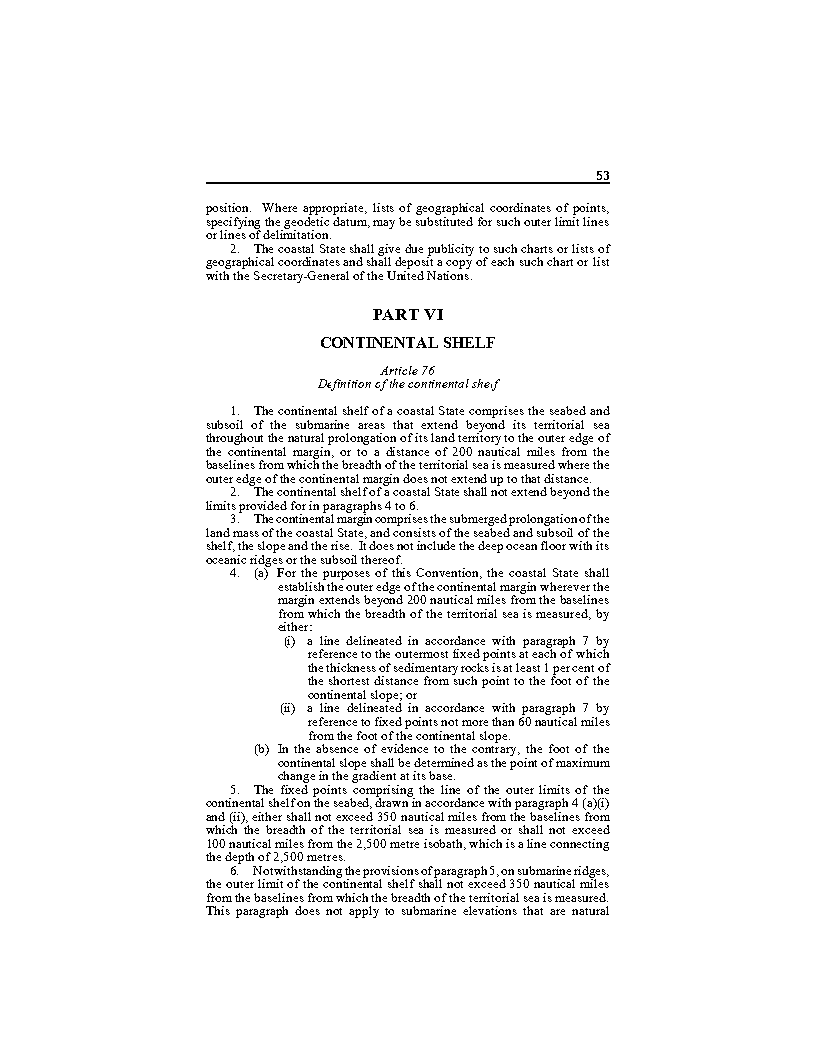
" (a) For the purposes of this Convention, the coastal State shall establish the outer edge of the continental margin wherever it extends beyond 200 nautical miles from the baselines from which the breadth of the territorial sea is measured by either: (i) a line delineated in accordance with paragraph 7 by reference to the outermost fixed points at each of which the thickness of sedimentary rocks is at least 1 per cent of the shortest distance from such point to the foot of the continental slope; or (ii) a line delineated in accordance with paragraph 7 by reference to fixed points not more than 60 nautical miles from the foot of the continental slope. (b) In the absence of evidence to the contrary, the foot of the continental slope shall be determined as the point of maximum change in the gradient at its base."
DEFINITION OF TERMS IN THIS CLAUSE
➡ line along the coast of a coastal State as marked on large-scale charts officially recognised by the coastal State which acts as the starting point for measuring the breadth of the sea around a coastal state.
➡ land beside or near to the sea or ocean
➡ connected with ships, sailors and sailing, seamanship, marine navigation.
➡ a unit used in measuring distances at sea, equal to 1,852 metres (approximately 2,025 yards), or one minute of arc along the Earth’s equator.
➡ the salt water that covers most of the earth's surface and surrounds its continents and islands




Please log in or register to access this content. Logging in will grant you acess to subscriber contents like unlimited access to our articles, glossaries, lexicons, quizzes, downloads, forum participation, etc.