Read entire PDF
Opens in new tab ↗️


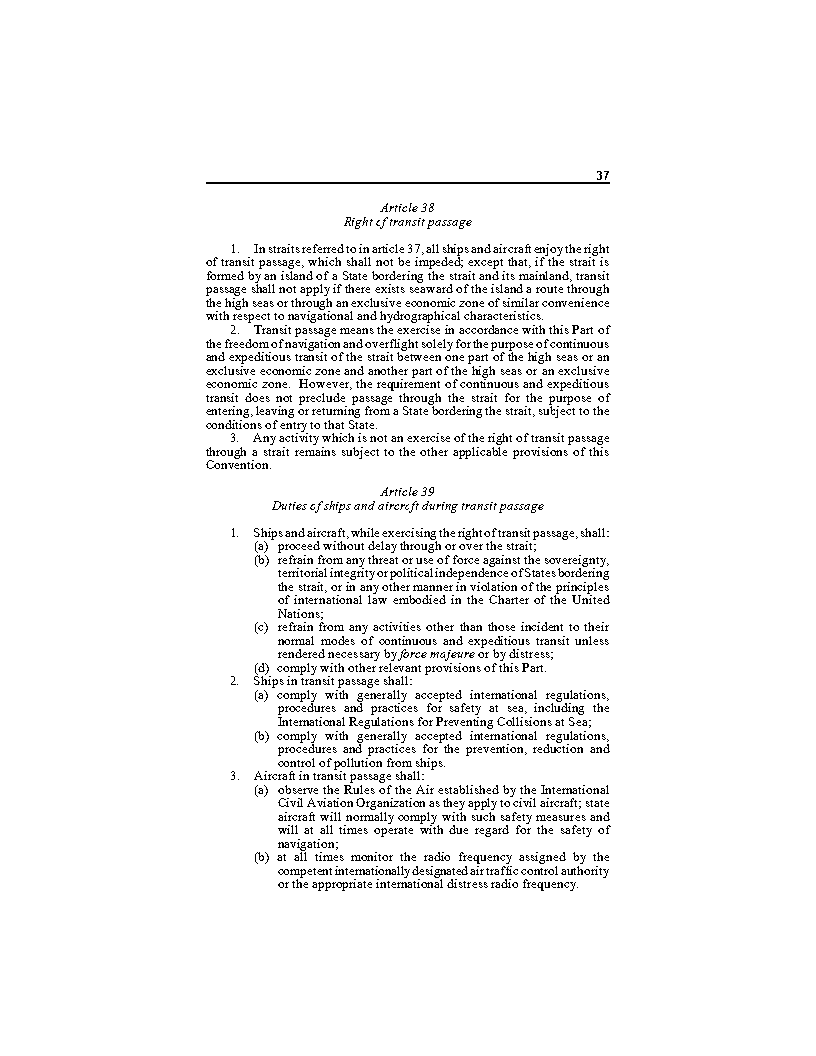
" Ships and aircraft, while exercising the right of transit passage, shall: (a) proceed without delay through or over the strait; (b) refrain from any threat or use of force against the sovereignty, territorial integrity or political independence of States bordering the strait, or in any other manner in violation of the principles of international law embodied in the Charter of the United Nations; (c) refrain from any activities other than those incident to their normal modes of continuous and expeditious transit unless rendered necessary by force majeure or by distress; (d) comply with other relevant provisions of this Part."
DEFINITION OF TERMS IN THIS CLAUSE
➡ Rivage, berge, côte d’une étendue d’eau. Un bord de mer.
➡ Passage means navigation through the territorial sea for the purpose of: a) traversing that sea without entering internal waters or calling at a roadstead or port facility outside internal waters; or (b) proceeding to or from internal waters or a call at such roadstead or port facility.
➡ On entend par «passage» le fait de naviguer dans la mer territoriale aux fins de: a) la traverser sans entrer dans les eaux intérieures ni faire escale dans une rade ou une installation portuaire située en dehors des eaux intérieures ou b) se rendre dans les eaux intérieures ou les quitter, ou faire escale dans une telle rade ou installation portuaire ou la quitter.
➡ a large boat that carries people or goods across the seas or oceans
➡ a narrow passage of water that connects two larger bodies of water.
➡ exercise of the freedom of navigation and overflight solely for the purpose of continuous and expeditious transit of the strait between one part of the high seas or an exclusive economic zone and another part of the high seas or an exclusive economic zone.




Please log in or register to access this content. Logging in will grant you acess to subscriber contents like unlimited access to our articles, glossaries, lexicons, quizzes, downloads, forum participation, etc.