Read entire PDF
Opens in new tab ↗️


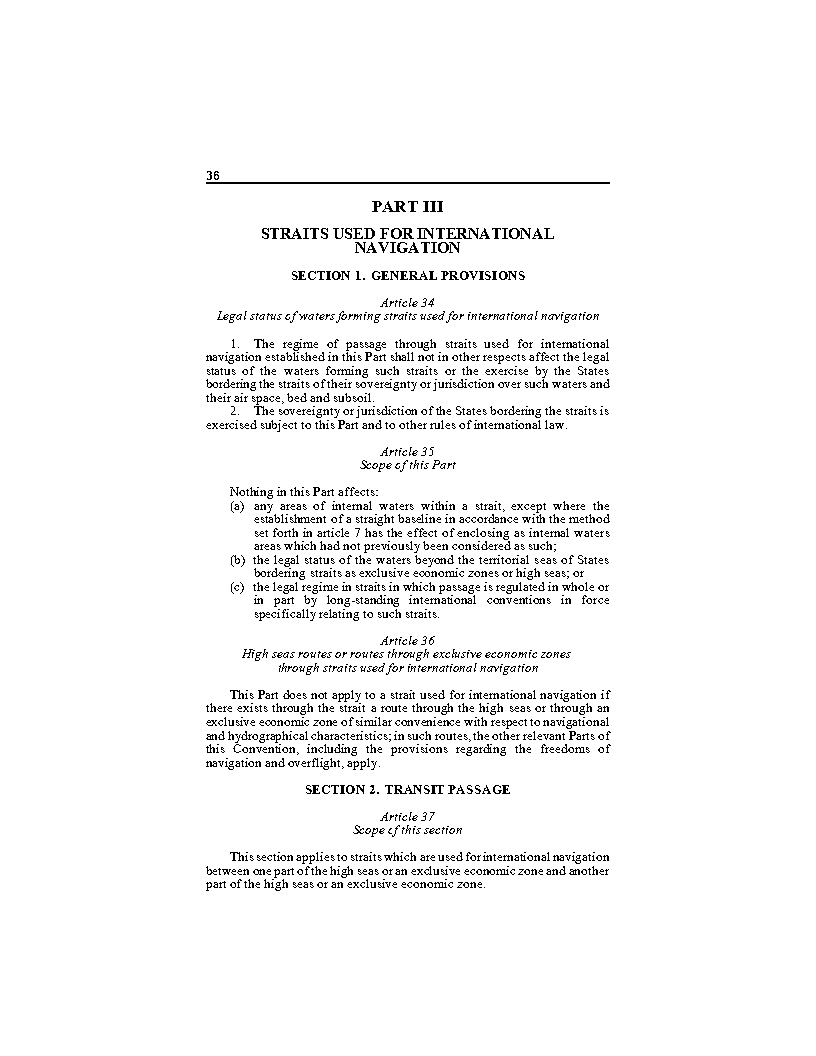
" Nothing in this Part affects: (a) any areas of internal waters within a strait, except where the establishment of a straight baseline in accordance with the method set forth in article 7 has the effect of enclosing as internal waters areas which had not previously been considered as such; (b) the legal status of the waters beyond the territorial seas of States bordering straits as exclusive economic zones or high seas; or (c) the legal regime in straits in which passage is regulated in whole or in part by long-standing international conventions in force specifically relating to such straits."
DEFINITION OF TERMS IN THIS CLAUSE
➡ line along the coast of a coastal State as marked on large-scale charts officially recognised by the coastal State which acts as the starting point for measuring the breadth of the sea around a coastal state.
➡ Rivage, berge, côte d’une étendue d’eau. Un bord de mer.
➡ Abbreviation for Exclusive Economic Zone (defined in the Law of the Sea Convention).
➡ Passage means navigation through the territorial sea for the purpose of: a) traversing that sea without entering internal waters or calling at a roadstead or port facility outside internal waters; or (b) proceeding to or from internal waters or a call at such roadstead or port facility.
➡ On entend par «passage» le fait de naviguer dans la mer territoriale aux fins de: a) la traverser sans entrer dans les eaux intérieures ni faire escale dans une rade ou une installation portuaire située en dehors des eaux intérieures ou b) se rendre dans les eaux intérieures ou les quitter, ou faire escale dans une telle rade ou installation portuaire ou la quitter.
➡ the salt water that covers most of the earth's surface and surrounds its continents and islands
➡ a narrow passage of water that connects two larger bodies of water.
➡ a liquid without colour, smell or taste that falls as rain, is in lakes, rivers and seas, and is used for drinking, washing, etc




Please log in or register to access this content. Logging in will grant you acess to subscriber contents like unlimited access to our articles, glossaries, lexicons, quizzes, downloads, forum participation, etc.