


Aquaculture - meaning and illustration

📘 TABLE OF CONTENTS
⌚ Reading time:
📆 Last modified:
2026-09-20 01:40:45
1. Synonyms, etymology, translation, definition, examples and notes
1.1. IPA transcription and prononciation for aquaculture: 🔊
- aquaculture: Amer. |ˈækwəkʌltʃər| Brit. |'ækwəkʌltʃə|;
- aquafarming |ˈækwə ˈfɑːmɪŋ|;
- halieucultures /ˌhalēˈ(y)ükʌltʃə/;
1.2. Synonyms of aquaculture:
2 international synonym(s) for aquaculture. Notably:
- 🍧 Aquafarming 🔊 ⏸•ılıılıılııl 0
- 🍧 Halieuculture 🔊 ⏸•ılıılıılııl 0
1.3. Etymology of Aquaculture:
- Aquaculture: from the affix of Latin origin aqua-, ‘water’, and -culture, ‘to take care of’.
- Halieuculture: borrowed from Latin halieutica or French halieutique;
- Aquafarming: from Latin aqua- + farming;
The term aquaculture is likely to originate in the 1950s and gradually became popular till it go to its peak of popularity in the early 1990s. Another synonym, aquafarming is seldom used interchangeably with aquaculture, but not yet adopted by venerated authors in the fisheries sector. Halieuculture is another very rare frenchism synonymous to aquaculture that may be used in hyper technical documents.
1.4. 🇫🇷 French translation of aquaculture:
- Aquaculture
- Halieuculture 🔊 ⏸•ılıılıılııl 0
1.5. Definition of aquaculture in fisheries:
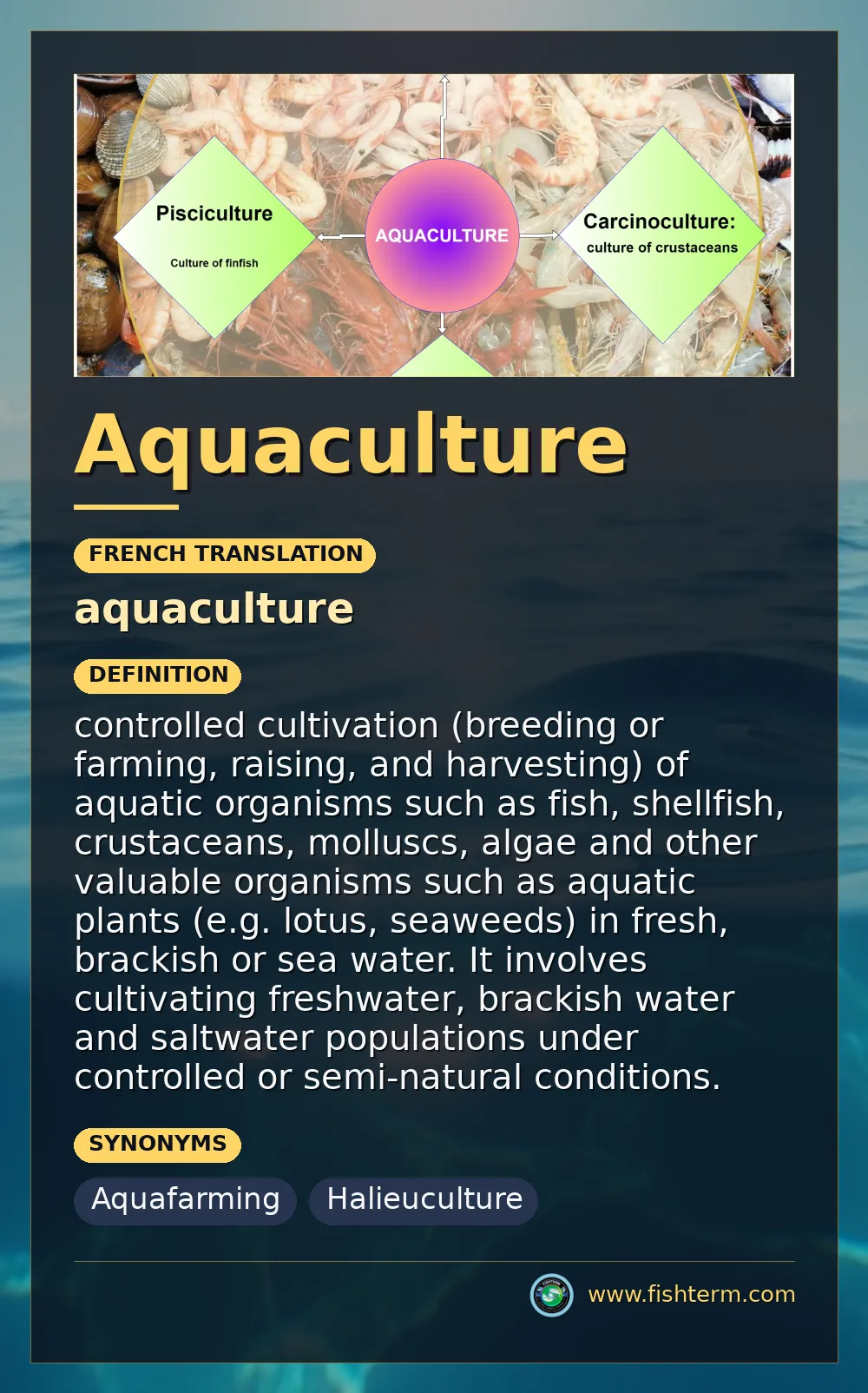
Aquaculture, also known as aquafarming or halieuculture, means: controlled cultivation (breeding or farming, raising, and harvesting) of aquatic organisms such as fish, shellfish, crustaceans, molluscs, algae and other valuable organisms such as aquatic plants (e.g. lotus, seaweeds) in fresh, brackish or sea water. It involves cultivating freshwater, brackish water and saltwater populations under controlled or semi-natural conditions.
9 Other Definitions of Aquaculture per Country
In All Countries:
'aquaculture' means the rearing or cultivation of aquatic organisms using techniques designed to increase the production of the organisms in question beyond the natural capacity of the environment, where the organisms remain the property of a natural or legal person throughout the rearing and culture stage, up to and including harvesting;
✏️ Source -- Regulation (EU) No 1380/2013 of the European Parliament and of the Council of 11 December 2013, Part 1, Article 4, Paragraph 25 ( Regulation (EU) No 1380/2013 of the European Parliament and of the Council of 11 December 2013 )
In Australia:
aquaculture means—
-
(a) cultivating fish or marine vegetation for the purposes of harvesting the fish or marine vegetation or their progeny with a view to sale, or
-
(b) keeping fish or marine vegetation in a confined area for a commercial purpose (such as a fish-out pond),
but does not include—
- (c) keeping anything in a pet shop for sale or in an aquarium for exhibition (including an aquarium operated commercially), or
- (d) anything done for the purposes of maintaining a collection of fish or marine vegetation otherwise than for a commercial purpose, or
- (e) any other thing prescribed by the regulations.
✏️ Source -- New South Wales Fisheries Management Act 1994, Part 6, Section 142 ( New South Wales Fisheries Management Act 1994 )
In Ghana:
"aquaculture" means an activity designed to cultivate or farm fish and any other living aquatic resources;
✏️ Source -- Ghana Fisheries Act, 2002, Part VI, Section 140 ( Ghana Fisheries Act, 2002 )
"farming", in relation to fish or any other marine vegetation, means the breeding, cultivating and rearing of fish or the cultivating of aquatic vegetation;
✏️ Source -- Ghana Fisheries Act, 2002, Part VI, Section 140 ( Ghana Fisheries Act, 2002 )
In Kenya:
“aquaculture” means the cultivation, propagation or farming of aquatic organisms, including fish, molluscs, crustaceans and aquatic plants whether from eggs, spawn, spat, seed or other means or by rearing fish lawfully taken from the wild or lawfully imported into Kenya, or by other similar process;
✏️ Source -- Kenya Fisheries Management and Development Act, 2016, Part I, Section 2 ( Kenya Fisheries Management and Development Act, 2016 )
“farming of aquatic organisms” means an organised rearing process involving propagation, breeding, regular stocking, feeding or protection from predators and harvesting of cultured aquatic organisms and plants or other similar intervention in the organisms' natural life cycles;
✏️ Source -- Kenyan Fisheries Management and Development (Aquaculture) Regulations.pdf, Part I, Section 2 ( Kenyan Fisheries Management and Development (Aquaculture) Regulations.pdf )
"Aquaculture" means the cultivation of live fisheries resources for sale other than in circumstances prescribed under a regulation;
✏️ Source -- Migori County Fisheries and Aquaculture Act, 2016, Part I, Section 3 ( Migori County Fisheries and Aquaculture Act, 2016 )
In Seychelles:
“aquaculture” means —
- a) the cultivation, propagation or farming of fish;
- b) includes the cultivation, propagation or farming of aquatic organisms from eggs, spawn, spat, fragment or seed, as well as the rearing of fish taken from the wild or imported into Seychelles, or through similar process; and
- c) the collection and holding of live fish, under controlled conditions for purposes such as trade, business or research
✏️ Source -- SEYCHELLES FISHERIES AND AQUACULTURE ACT, 2025, Part 1, Section 2, Sub-section 1 ( SEYCHELLES FISHERIES AND AQUACULTURE ACT, 2025 )
In United Kingdom:
“aquaculture” means the breeding, rearing, growing or cultivation of—
- (a) any fish or other aquatic animal,
- (b) seaweed or any other aquatic plant, or
- (c) any other aquatic organism;
✏️ Source -- UK Fisheries Act 2020, Section 52 ( UK Fisheries Act 2020 )
1.6. Plural of aquaculture:
Aquacultures; halieucultures; aquafarmings;
2. Notes on aquaculture
Aquaculture has several sub-sectors, some of which are subdivided into several other branches. Some of the Main subsectors of aquaculture include:
- Aquaponics: extensive polyculture integrating fish, molluscs and a multiplicity of plants in the form of a symbiosis, which feed on wastes that is in turn transformed by bacteria;
- Fish farming: breeding of fish;
- Shellfish farming: farming of shellfish;
- Carcinoculture: culture of crustaceans;
- Algaculture/Algoculture: cultivation of algae;
- Integrated multi-trophic aquaculture (IMTA)
NB: Some people tend to refer to aquaculture as fish farming. Aquaculture is not the same as fish farming. Fish farming is just one part of aquaculture. A detailed classification of the branches of aquaculture can be found here.
Purpose of aquaculture:
Aqua farming is done with the following objectives in mind:
- to enhance production of available species through regular and controlled stocking, feeding and harvesting;
- to protect endangered species from predators by providing a culture environment which is hostile to predators and friendly to targeted species;
- to help restore depleted aquatic populations;
The Sumerians supplemented food supplies by maintaining fish in artificial ponds more than 4,500 years ago. According to records, ancient Egypt and Assyria also kept fish, and the Chinese were breeding carp for food by 1000 b.c. The ancient Romans kept fish for food and entertainment by circulating fresh seawater through aquariums.
Aquaculture classificationAquaculture, just like agriculture is a very broad sector with great diversity. As such, a simple classification is shown below according to different culture parameters of the activity:
Classification of aquaculture by water salinity:Mariculture or marine aquaculture:
cultivation of aquatic species such as fish (cobia, salmon) or shellfish (scallops, oysters, oysters, mussels), macroalgae (seaweeds), among others in sea water.
Freshwater aquaculture:
It means aquaculture within inland waters. It is the cultivation of aquatic species such as fish or shellfish, macroalgae (seaweeds), among others in sea fresh water.
Brackish water or estuarine water aquaculture:
aquaculture in estuarine waters. It is practiced in environments where the concentration of salt varies and salinity ranges between fresh water and saline water.
Classification of aquaculture by the level of water exchangeStatic aquaculture systems:
These are traditionally extensive ponds or tanks, where artificial water exchanges are used during the cultivation period.
Open aquaculture systems:
The cultivated organisms are confined or protected like in for example a tank, cages, pens, with no artificial circulation of water or within the system, the flow and quality of the water is maintained by natural water currents (stream, river, lakes or ocean).
Closed or recirculation aquaculture systems:
These aquaculture systems have minimal water exchange during the production cycle with minimal contact with the environment and the original water source. The same water is continuously purified and reinjected into the culture system
Classification of aquaculture based on Seed OriginDomesticated Aquaculture: Seeds come from artificial reproduction conducted in hatcheries.
Capture-Based Aquaculture: this type of aquaculture relies on the use of wild seed fished from their natural environment.
Classification of aquaculture By the level of intensity of activitiesExtensive or traditional aquaculture:
Simplest form of culture involving protection of the stock to improve survival rates of wild juveniles, where no fertilizer or supplementary feed is added and the production from the pond depends entirely on the primary production. The primary production in turn depends on sunlight and nutrients available in the water and soil. In the case of fish culture, it is carried out in ponds, where the fish feed on the primary production of the body of water, for this, fertilization is used. Traditional aquaculture systems have low cultivation densities, such as one fish / m2, and their productions are less than 500 kilograms per hectare.
Semi-intensive aquaculture:
A form of sea culture involving increased production by stocking at a slightly higher density and adding fertilizers (organic or inorganic) to increase primary production within the pond and in turn increase the harvest from the pond. For example, Semi-intensive fish farming is often carried out in constructed ponds which are fertilized (organic or chemical) and balanced food is provided to the animals in a complementary way. The density is between 1 and 5 fish / m2. Sometimes in these systems aeration is used that usually covers 10 to 15% of the pond area.
Intensive System:
It is carried out in ponds, cages, raceways or tanks, with permanent control of the quality of the water, feeding and production. Aeration is usually used in at least 50% of the pond area. The diet will depend only on artificial diets. The density is between 5 to 20 fish / m2, this will depend on the exchange of water and aeration supplied to the pond.
Superintensive or hyperintensive systems:
A form of mariculture involving higher stocking rates, increased depth of water (>40cm depth), increased supplementary feed with or without the use of fertilizers. Water depth in the rearing structure is greater than in the former sea farming types because the food for the cultivated organisms is not dependent entirely on primary production within the pond. Superintensive and hyperintensive aquacultures are carried out mainly in tanks, under strict control of all factors, mainly water quality, aeration and feeding. haracterised by high production cost, the culture density used is greater than 20 fish / m2; but, the peak production density reached depends on being able to keep up good water quality conditions for the organisms in culture.
Classification of aquaculture by the number of species:Monoculture aquaculture system:
Only one species is cultivated. For example, the cultivation of only tilapia or only salmon.
Polyculture aquaculture system:
Here, two or more species are raised in the same pond or culture system. The most important consideration in polyculture is the likelihood of increasing fish production, through better use of natural foods or area of farming systems. For example, the cultivation of tilapia, shrimp and rice in the same pond. Polyculture seeks to take advantage of all the space and sets a mutualistic relationship among reared species. In this our example, the tilapia live in the water column and the shrimp in the bottom of the pond. The growing rice absorbs the waste from the tilapias and shrimps.
Integrated aquaculture:
The organic waste from the cultivation of other animals such as ducks or pigs is used, which is used for the production of microalgae, which will be food for the fish. Integrated farming has advanced further and some examples of integrated aquaculture include rice-fish farming, aquaponics, biofloc, integrated multitrophic aquaculture (IMTA) and aquamimetics. One difference between integrated aquaculture and polyculture is that the species involved in integrated aquaculture may not be raised in the same pond or rearing structure, but their rearing water may be linked through canals for nutrient transfer.
Fishery terminology records for Aquaculture
 Linkedin
 share
share tweet
tweetLEAVE A COMMENT