
Major Plastic Pond Types, Sizes, Prices and Uses
Plastic ponds are widely used in aquaculture due to their affordability (one of the most cost-effective options on the market), ease of installation, and flexibility. In case you are interested in purchasing a plastic pond for your project, this write-up will guide you in making the right choice.
What is a plastic pond?
A plastic is a synthetic material made from a wide range of organic polymers such as polyethene, PVC, nylon, etc., that can be moulded into shape while soft, and then set into a rigid or slightly elastic form. In fisheries or aquaculture, mostly polyethene (polyethylene in American English) and PVC plastics are used to retain water.
Plastic ponds may be standalone structures made from moulded plastic or ponds lined with plastic sheets stretched over earthworks. They are advantageous for their ease of installation, scalability, and longevity across different climates and settings. For a more formal definition, see the definition of plastic pond in our dictionary.
Types of plastic ponds
In aquaculture contexts, plastic ponds are often portable or semi-permanent water reservoirs equipped with inflow and outflow features that support the farming of fish or other aquatic organisms. However, the choice of material (e.g., PVC vs HDPE vs Preformed) will influence the pond’s flexibility, lifespan, maintenance needs, and suitability for particular environmental conditions.
Plastic ponds will be classified under two main classification criteria: their material type and their shapes.
1. Types of plastic ponds based on materials
Based on material, plastic ponds can be classified under Polyvinyl Chloride (PVC) plastic, Preformed plastic and Flexible Polyethene Plastics (Just as mentioned above, the polymer relevant to pond structures is Polyethene).
Flexible Polyethene Plastics Liners come in:
- HDPE (High-Density Polyethene) – A strong, UV-resistant material, often used for larger ponds due to its puncture and tear resistance;
- LLDPE (Linear Low-Density Polyethene) – A more flexible and weldable version of polyethylene, suitable for fish ponds;
- RPE (Reinforced Polyethene) – Reinforced Polyethene, often preferred for larger ponds due to its strength and UV resistance;
- Reinforced Polypropylene (RPP): Suitable for smaller fish ponds;
- PVC: A common and affordable option, but requires protection from UV exposure;
- EPDM: A more durable and flexible option than PVC, but may not be rated for full sun exposure.
Of these Flexible Polyethene Plastics, just the HDPE Plastic is most popularly used as a liner.
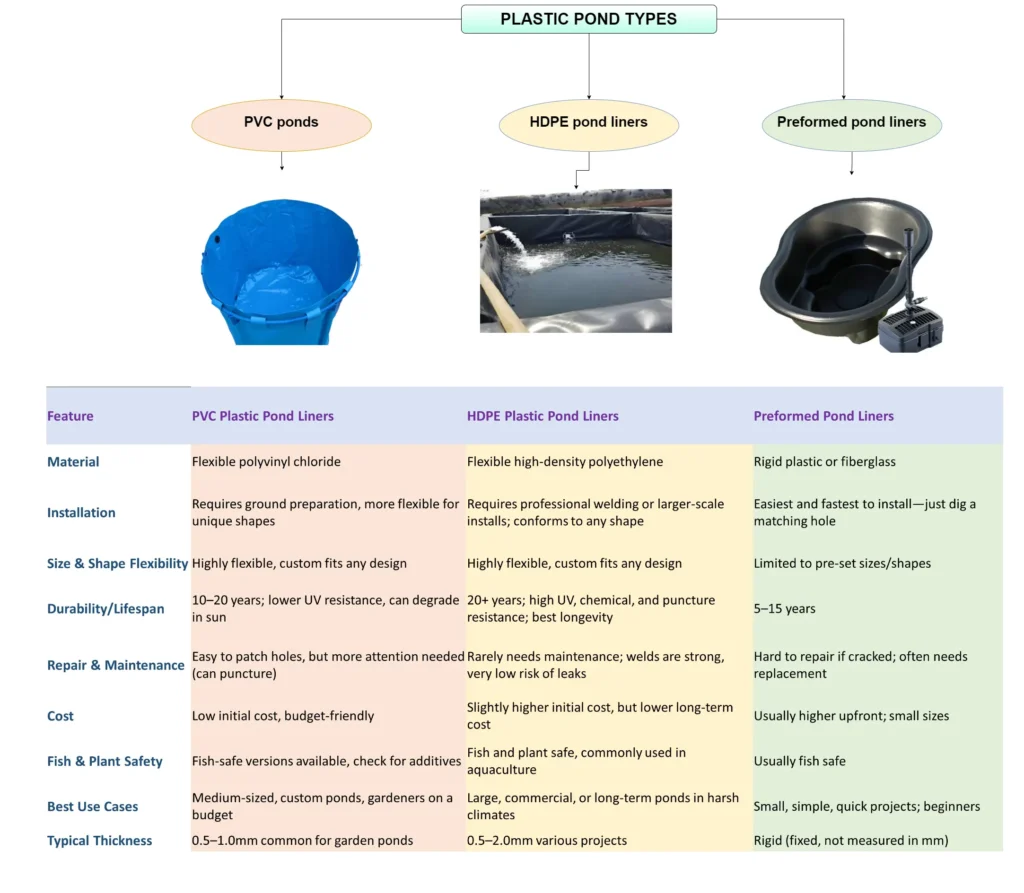
That said, there are typically three main types of plastic ponds based on the plastic material that we are going to examine. They include: High-Density Polyethene (HDPE) plastic ponds; Polyvinyl Chloride (PVC) plastic ponds, and Preformed plastic ponds (made from plastic or a blend of fibre glass and plastic).
1. High-Density Polyethene (HDPE) plastic ponds: Tough, chemically resistant, and weather durable, suitable for permanent large-scale fish farming installations. They are equally referred to as HDPE geomembranes or HDPE liners.
2. Polyvinyl Chloride (PVC) plastic ponds: More flexible and lighter than HDPE, suited for smaller or temporary ponds, allowing easy customisation and relocation.
3. Preformed plastic ponds/pond liners: Often simply called Preformed plastic ponds, they are a popular alternative to using a traditional flexible pond liner. They are moulded from plastic or fibreglass and available in a large number of definite shapes and sizes. When used with the right motivation, a pond builder can create a successful pond using a preformed liner.
Examples include:
- MacCourt and Algreen pre-formed ponds. They are known for their durability and resistance to temperature fluctuations. However, it is important to note up front that there are limitations to the preformed approach, and it is important to be aware of these before choosing a liner for your pond.
- Bermuda pre-formed ponds are ready-made ornamental garden ponds made from tough high-density polyethylene (HDPE). They come shaped and designed for easy installation and optimal functionality, including perfect placement for pumps and plants, as well as wildlife access and escape routes. You simply dig a hole, drop the pond in, and fill it up—no pond liner is needed. These ponds are ideal for small to medium-sized garden water features
| Feature | PVC Plastic Pond Liners | HDPE Plastic Pond Liners | Preformed Pond Liners |
|---|---|---|---|
| Material | Flexible polyvinyl chloride | Flexible high-density polyethylene | Rigid plastic or fiberglass |
| Installation | Requires ground preparation, more flexible for unique shapes | Requires professional welding or larger-scale installs; conforms to any shape | Easiest and fastest to install—just dig a matching hole12 |
| Size & Shape Flexibility | Highly flexible, custom fits any design | Highly flexible, custom fits any design | Limited to pre-set sizes/shapes |
| Durability/Lifespan | 10–20 years; lower UV resistance, can degrade in sun | 20+ years; high UV, chemical, and puncture resistance; best longevity | 5–15 years |
| Repair & Maintenance | Easy to patch holes, but more attention needed (can puncture) | Rarely needs maintenance; welds are strong, very low risk of leaks | Hard to repair if cracked; often needs replacement |
| Cost | Low initial cost, budget-friendly | Slightly higher initial cost, but lower long-term cost | Usually higher upfront; small sizes |
| Fish & Plant Safety | Fish-safe versions available, check for additives | Fish and plant safe, commonly used in aquaculture | Usually fish safe |
| Best Use Cases | Medium-sized, custom ponds, gardeners on a budget | Large, commercial, or long-term ponds in harsh climates | Small, simple, quick projects; beginners |
| Typical Thickness | 0.5–1.0mm, common for garden ponds | 0.5–2.0mm various projects 1 | Rigid (fixed, not measured in mm) |
Now, let us compare the economic and physical features of these three types of plastic ponds
| Feature | PVC Plastic Pond | HDPE Plastic Pond Liners | Preformed Pond Liners |
|---|---|---|---|
| Price Range | $0.30–$0.90/sq ft; £2.65–$12 per m² common for garden grades | $0.30–$0.60/sq ft, or around ₹22–200/m² (₹10–20/sq ft) in some markets | $50–$460 for small units, or $0.25–$1.50/sq ft (rigid plastic), higher for fiberglass |
| Sizes | Sheet sizes: Minimum ~2x2m (6.5×6.5ft), maximum up to 25x30m (82x98ft); fully customizable | Sheet sizes: Range from small to very large, easily custom-cut to pond needs | Typically 40–400gal (rarely over 750L/200gal); fixed, limited sizing |
| Shapes | Unlimited—fits any design (freeform, rectangular, round, formal, or naturalised) | Unlimited—fits complex shapes, water features, formal or organic styles | Only as manufactured—common options: ovals, rectangles, kidney, circles, streams |
| Volume | Scalable by sheet size and pond depth—commonly from hundreds to many thousands of gallons | Scalable by liner area—can cover large ponds or lakes; no practical volume limit for most uses | Usually up to 400gal (1,500L), rarely as much as 750gal (2,800L) possible |
Based on materials, the prices of plastic ponds vary across regions in the world. They could equally be ordered on online platforms like Alibaba in various shapes and dimensions.
2. Types of plastic ponds based on shape and toughness
Plastic fish ponds can be classified based on their shapes. Plastic ponds based on shape are generally of two categories: Preformed and moulded rigid shapes (fixed oval, kidney, rectangular, circular); and Flexible liners shaped on-site to freeform or standard shapes (rectangular, circular, kidney, irregular)
-
Preformed Plastic Ponds (Rigid/Precast Shapes)
-
These ponds come in a variety of fixed, moulded shapes and sizes.
-
Common shapes include oval, kidney-shaped, rectangular, circular, and freeform designs.
-
Preformed ponds are made from durable plastics such as polyethene or fiberglass and are rigid enough to maintain their shape without excavation support.
-
Their shapes often aim to mimic natural pond contours or fit into specific landscape designs.
-
They are typically smaller to medium-sized, convenient for garden or small farm setups.
-
-
Flexible Plastic Liner Ponds (Freeform Shapes)
-
These ponds use flexible plastic sheets or liners (often HDPE or PVC) that can be shaped on-site to almost any form desired by excavation or embankment construction.
-
The shape is not fixed and can be customised for size, depth, and contour according to the site and purpose.
-
Shapes can be round, oval, kidney-shaped, rectangular, or irregular/freeform—depending on the digging pattern or frame used.
-
Flexible liners allow creative and adaptive pond construction, suitable for small-scale to larger aquaculture applications.
-
2. Types of plastic ponds based on ground level
2.1. Above-ground plastic ponds: These are plastic ponds that are installed above the ground. Above-ground plastic ponds come in various types, including those made from flexible liner material, preformed plastic shells, and those constructed using wood or galvanised pipes lined with plastic.
2.2. In-ground plastic pond: often called below-ground or underground plastic ponds, are installed beneath the ground. They range from flexible ponds with polyethene liners to rigid preformed ponds. Preformed ponds are durable basins made from heavy-duty plastic and are designed to be set into the ground.
Where to Buy Plastic Ponds
You can purchase in-ground plastic ponds both in-store and online from a variety of retailers and specialised pond suppliers, such as:
-
Lowe’s: Offers plastic ponds, pond liners, and preformed pond shells that are easy to install.
-
The Pond Outlet: Sells a range of preformed plastic ponds in various sizes and shapes, starting from around $125 up to thousands for larger models 5.
-
Speciality garden centres/online stores: Sites like Pondkeeper, Water Gardening Direct, and GardenSite provide a wide selection of rigid preformed pond liners, typically made from tough HDPE or fiberglass263.
-
General garden and hardware retailers: Retailers such as B&Q, Home Depot, or local garden centres frequently stock both preformed ponds and flexible pond liners for custom shapes
CONCLUSION
In summary, this flexibility of plastic ponds allows fish farmers to choose pond shapes that optimise space, water flow, and fish management needs. Preformed rigid ponds offer easy installation with a consistent shape, while flexible liner ponds offer maximum customisation.